3rd Latvian Farmers' Harvest Festival
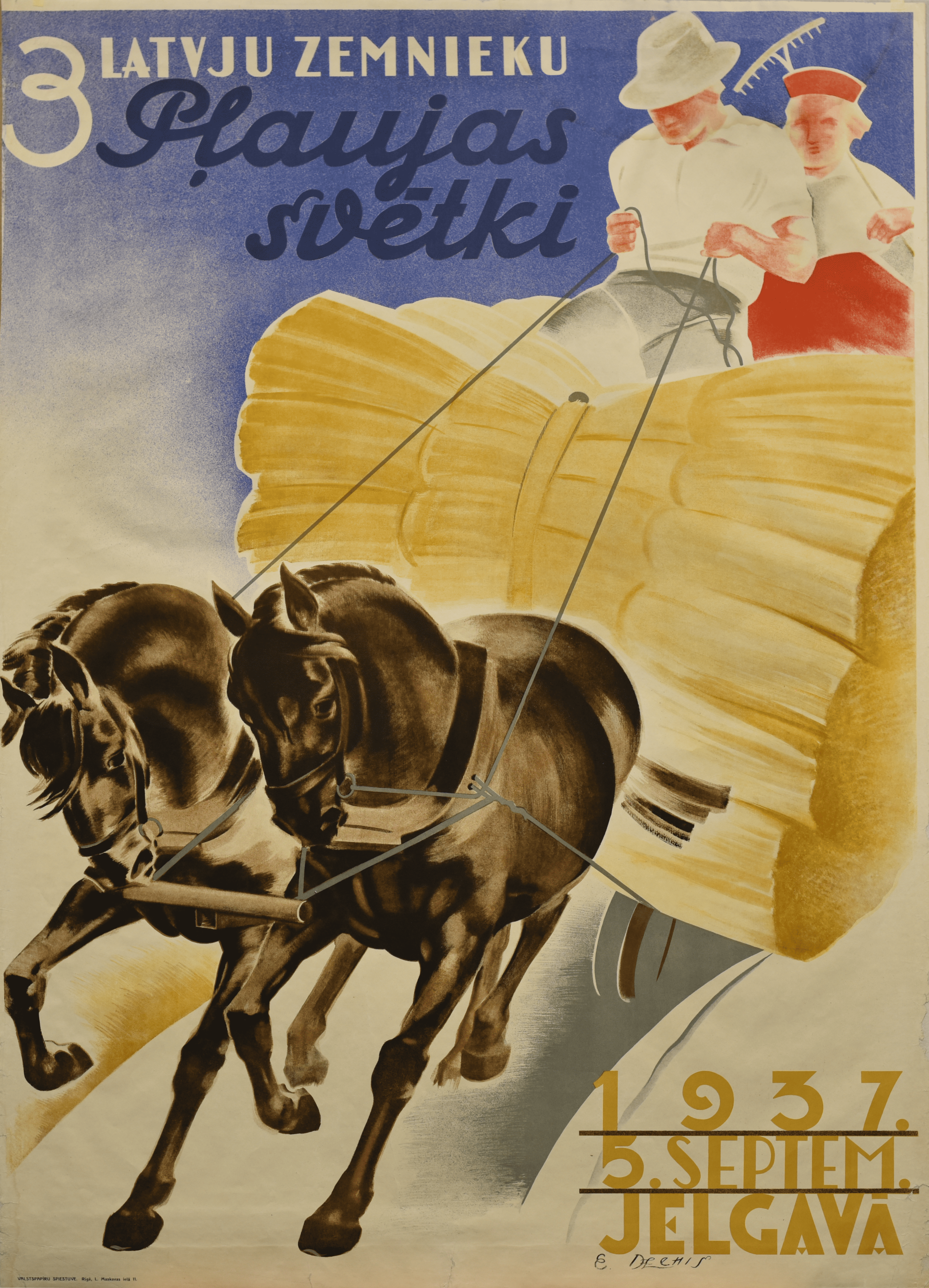


| AUTHOR | Eduards Dzenis |
| PERIOD | 1937 |
| TECHNIQUE | Poster |
| SIZE | - |
| PRICE | For sale from mid-2025 in The Hague |
Eduards Dzenis
Biography
Latvian graphic artist and painter Eduards Dzenis was born on April 18, 1907, in Vecpiebalga, into a peasant family. From an early age, he showed a keen interest in drawing. He studied at the Art Academy of Latvia, graduating in 1933 from the graphic arts workshop led by Rihards Zariņš (1869–1939).[1] After completing his studies, Dzenis worked as an assistant set designer at the Latvian National Opera, a drawing teacher at the Rīga School of Decorative and Applied Arts, and as a consultant for the Latvian Agricultural Chamber, where he created posters and illustrated the Chamber’s publications and magazines.
During World War II, on October 10, 1944, the artist was forced to flee the country with his family. They reached Sweden by boat, where he lived for seven years, working as a designer at the Swedish advertising company “Gumaelius”. In 1951, he moved to Toronto, where he continued his career in advertising as a designer and illustrator for the major agency “Bomac”. He actively participated in the artistic life of the Latvian diaspora and was one of the founding members and organizers of the Latvian artists’ association “Latvis” in Canada.
The artist died on November 11, 1999, in Toronto.[2]
Artistic style
At the beginning of his artistic career, Dzenis focused primarily on figurative genre compositions, scenes of everyday life, portraits, landscapes, and still lifes. His graphic works often centered on themes related to his homeland. Until the end of the 1930s, traditional themes dominated his work, which he expressed in illustrative and applied graphics. In 1937, he was awarded a gold medal at the International Exhibition in Paris for a poster dedicated to the Harvest Festival.
Dzenis worked using his own technique, which combined graphic expression and pastel painting. While living in Sweden, he created a series of pastels depicting scenes from the lives of refugees. His move to Toronto marked a new stage in the artist’s career, with his works acquiring a harsh expressiveness, simplicity of form, and deformation. At this time, Dzenis mainly painted horses and people in full length, using a vivid palette of red, white, gray, and black.[3] [4]
Throughout his artistic career, Dzenis took part in exhibitions organized by the Latvian Cultural Foundation. While living in Sweden, his works were shown in several exhibitions at a gallery in Stockholm and at a museum in Malmö. After relocating to Canada, he organized both group and solo exhibitions in major cities, including Toronto, Ottawa, Vancouver, Boston, Chicago, Philadelphia, and New York.[5]
Interesting Facts
In 1967, the artist was awarded a prize by the North American Latvian Cultural Foundation for an altarpiece created for St. John’s Church in Toronto. In 1983, he received the Hopper Foundation Award for his 7x2 meter panoramic painting “Riga in 1560,” created in oil for the large hall of the Latvian Center in Toronto.[6]
_______________________________
[2] https://www.literatura.lv/personas/eduards-dzenis (vd. 04.07.2025)
[3] Siliņš J. Latvijas māksla 1915–1940 III – Stokholma: Daugava, 1993.–43.–44. lpp.
[4] Ņefedova I. Dzenis, Eduards // Māksla un arhitektūra biogrāfijās 1 / Atb. red. A. Vilsons, Rīga: Latvijas Enciklopēdija, 1995.–138. lpp.
[5] https://www.literatura.lv/personas/eduards-dzenis (vd. 04.07.2025)
[6] Ņefedova I. Dzenis, Eduards // Māksla un arhitektūra biogrāfijās 1 / Atb. red. A. Vilsons, Rīga: Latvijas Enciklopēdija, 1995.–138. lpp.