Carriers of Firewood
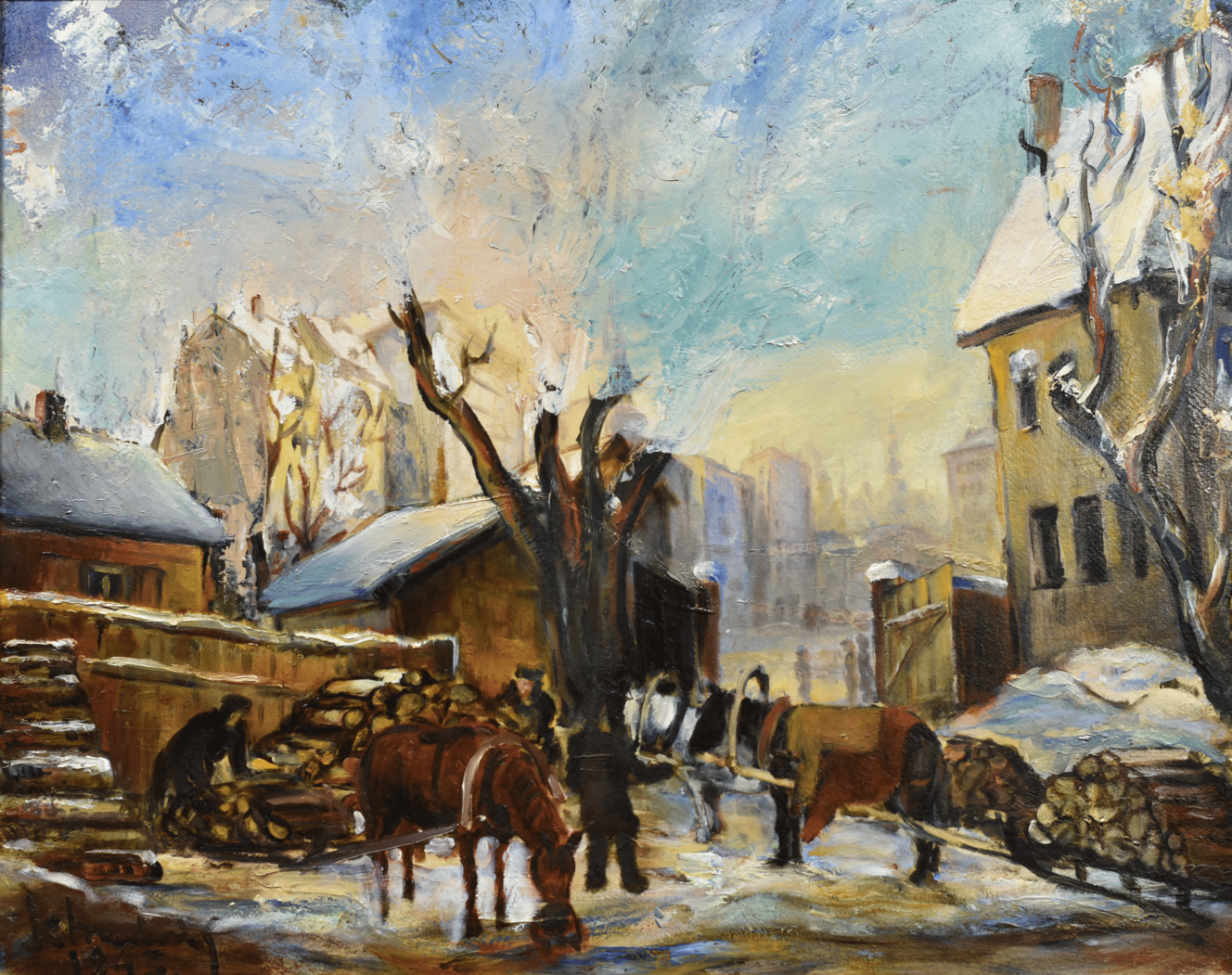
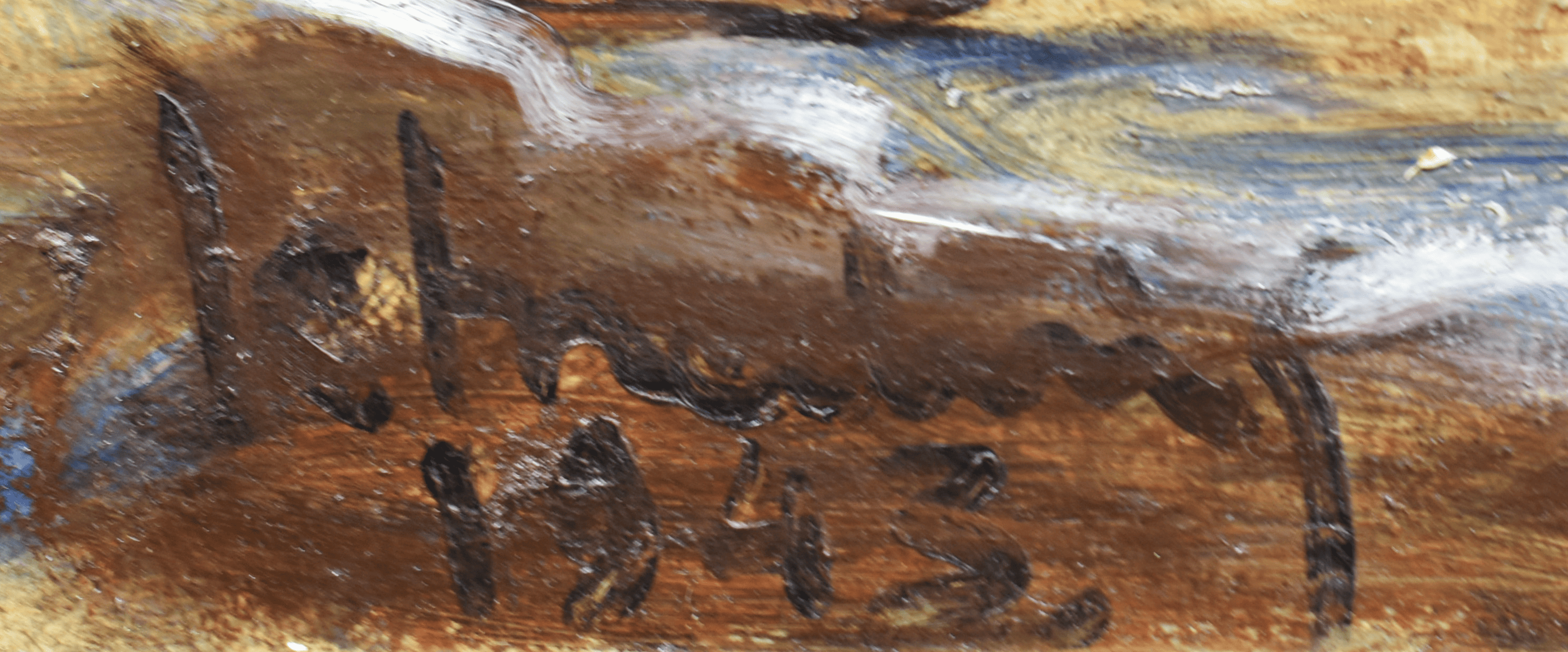
| AUTHOR | Kārlis Mednis |
| PERIOD | 1943 |
| TECHNIQUE | Oil on cardboard |
| SIZE | 57,5x72 cm |
| PRICE | For sale from mid-2025 in The Hague |
Kārlis Mednis
Biography
Latvian artist and illustrator Kārlis Mednis was born on April 1, 1940, in Penza, Russia. In 1928, he began studying painting in the studio of artist Romans Suta (1896–1944), later studying under Leo Svemps (1897–1975). During his education, he visited Italy, Germany, and the Scandinavian countries. In 1944, he emigrated to Germany, where he focused on graphic arts and became a member of the German Artists’ Union in Augsburg.[1] In 1949, he moved to Australia, where he studied at the Melbourne Art Gallery School under the guidance of landscape painter and renowned Australian portraitist William Dargie (1912–2003). In 1951, he relocated to Adelaide, where he continued his education at the Adelaide Central School of Art.[2]
Mednis taught art and actively participated in exhibitions of Latvian artists in exile. He was one of the founders of the Latvian artists’ group in Australia, “Zilā ota”, and a member of several Australian art organizations.
The artist died on August 12, 1999, in Melbourne.[3] [4]
Artistic style
Mednis’ artistic style is characterized by painting, in which he combines his skills as a draftsman with his work with various media. He created realistic cityscapes, figurative compositions, and views of ports using acrylic, enamel, and watercolor. His works are distinguished by their colorfulness, brightness, and rhythm.[5]
Mednis organized his first solo exhibition in 1960 in Melbourne, later held more than 40 solo exhibitions in Australia and the United States, and participated in about 400 group exhibitions. The artist’s works are included in the University of Melbourne Art Collection.[6] [7]
Interesting Facts
In 1966, Mednis decided to devote himself fully to painting and was commissioned to produce works for several public and private buildings in Australia.[8]
For his artistic contributions, he received recognition and numerous awards – including several Cato Awards, the Robin Hood Award, the Albury Society of Artists Award, and the Rowland Award.[9]
Mednis usually painted in the afternoon, first working on any unfinished pieces.[10]
__________________________________
[1] Ņefedova I. Mednis, Kārlis // Māksla un arhitektūra biogrāfijās, II / Atb. red. A. Vilsons. Rīga: Latvijas enciklopēdija, 1996, 107. lpp.
[2] Australian and New Zealand Art Sales Digest. Compiled by John Furphy. Available: https://www.aasd.com.au/artist/2684-karlis-mednis/ (vd. 13.08.2025)
[3] Ņefedova I. Mednis, Kārlis // Māksla un arhitektūra biogrāfijās, II / Atb. red. A. Vilsons. Rīga: Latvijas enciklopēdija, 1996, 107. lpp.
[4] https://www.literatura.lv/personas/karlis-mednis (vd. 13.08.2025)
[5] Ņefedova I. Mednis, Kārlis // Māksla un arhitektūra biogrāfijās, II / Atb. red. A. Vilsons. Rīga: Latvijas enciklopēdija, 1996, 107. lpp.
[6] https://www.literatura.lv/personas/karlis-mednis (vd. 13.08.2025)
[7]Australian and New Zealand Art Sales Digest. Compiled John Furphy. Available: https://www.aasd.com.au/artist/2684-karlis-mednis/ (vd. 13.08.2025)
[8] Ibid.
[9] Ņefedova I. Mednis, Kārlis // Māksla un arhitektūra biogrāfijās, II / Atb. red. A. Vilsons. Rīga: Latvijas enciklopēdija, 1996, 107. lpp.
[10] https://www.literatura.lv/personas/karlis-mednis (vd. 13.08.2025)