Horses with Carriages
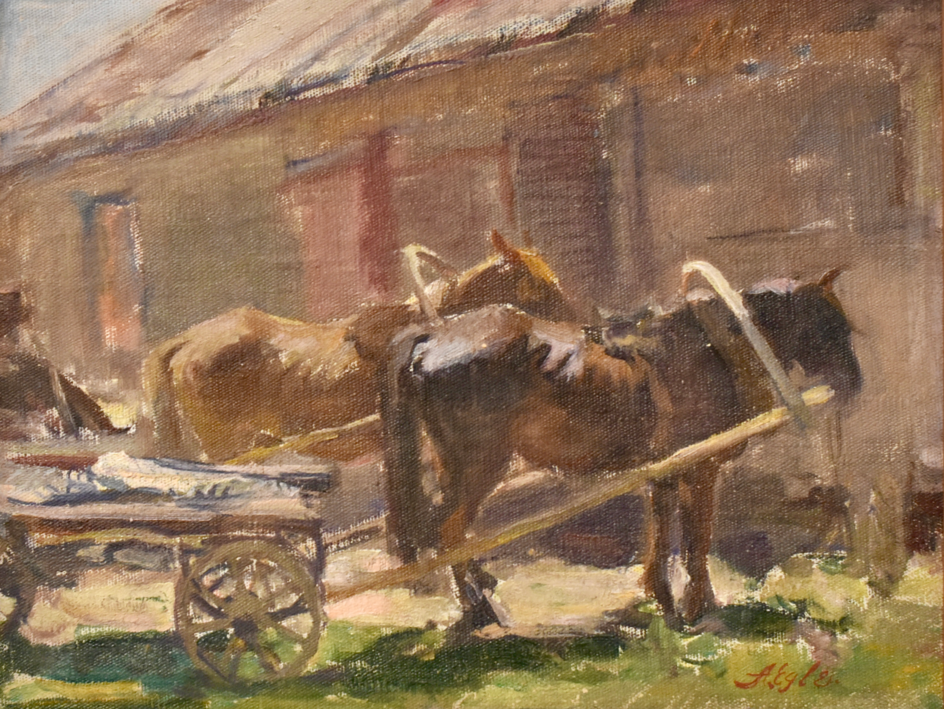
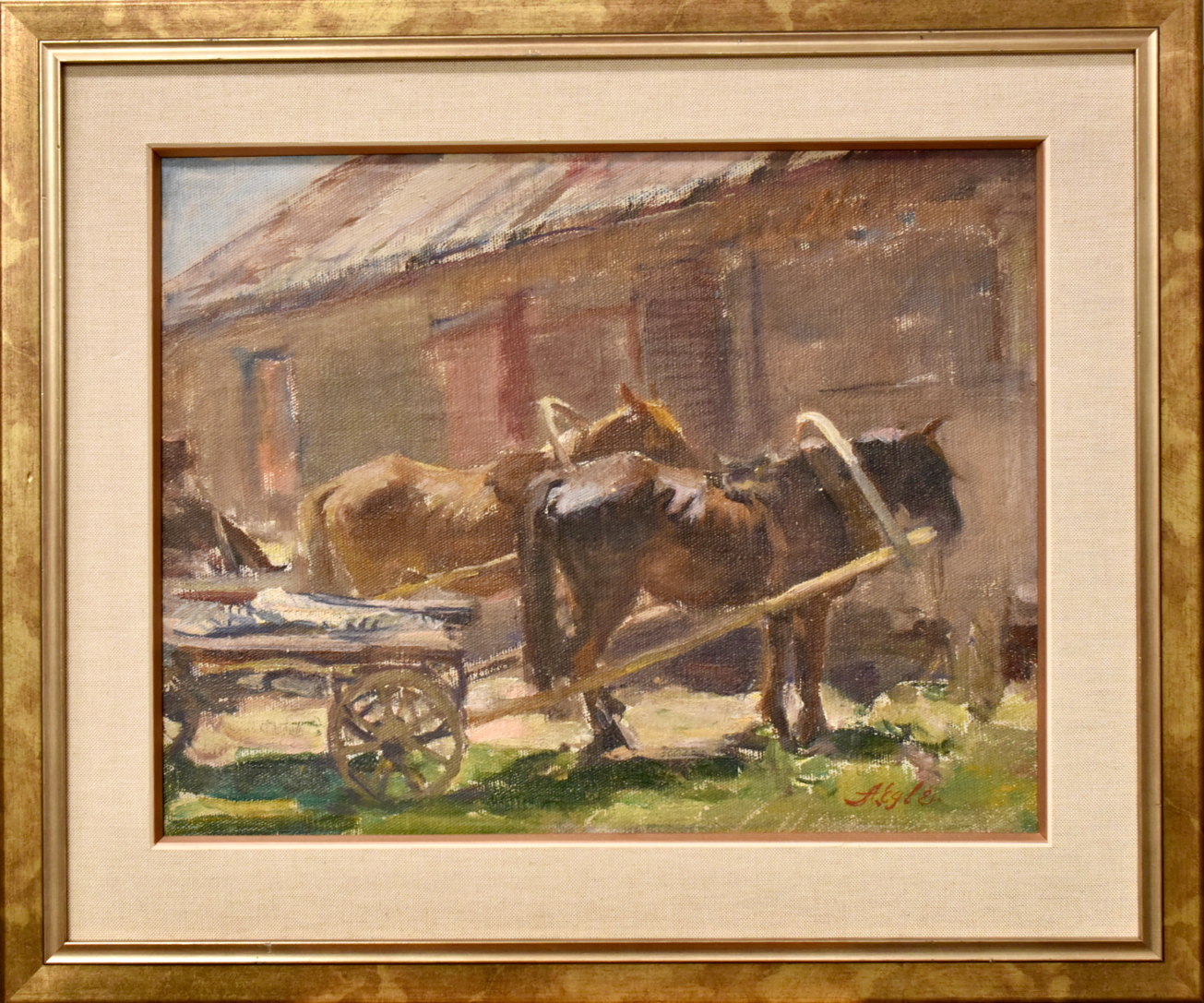
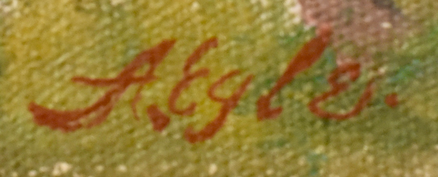
| AUTHOR | Arvīds Egle |
| PERIOD | 1960's |
| TECHNIQUE | Oil on canvas, cardboard |
| SIZE | 30x38,5 cm |
| PRICE | For sale from mid-2025 in The Hague |
Arvīds Egle
Biography
Latvian artist Arvīds Egle was born on April 3, 1905, in Lielsesava, near Jelgava, into the family of a servant. During World War I, his parents moved to Latgale. The family settled in Rēzekne, where Egle received his education and began studying drawing under Alberts Filka (1891–1938) and Francisks Varslavāns (1899–1949). In 1926, he enrolled at the Art Academy of Latvia and graduated in 1932 from the masterclass of Vilhelms Purvītis (1872–1945). While still a student, he worked as a scenographer at the Latgale Theater, and after graduating, he began exhibiting his work with a group of artists from the Mūkusala Art Society.
After completing his studies in Rīga, Egle returned to Rēzekne, where he taught drawing in local schools and played an active role in developing the artistic life of Latgale. Starting in the 1950s, he worked as a lecturer at the Art Academy of Latvia.[1] Together with his students and colleagues, Egle took part in summer plein air sessions, and for several years, one of his favorite places was the romantic and picturesque town of Salacgrīva.
Egle was a very reserved and emotionally closed person – he was critical of both himself and others, especially his students. At the same time, he was a dedicated teacher who devoted much of his life to painting. In 1954, he wrote a methodological text titled “Two Approaches to Drawing from Life”, which he later expanded. In this work, he summarized his practical and theoretical experience in teaching, analyzing different types of drawing, composition, light and shadow, and proportion. The material was intended for young students and pupils of art schools.
The artist died on November 20, 1977.[2]
Artistic Description
The artist is considered one of Purvītis’ best students. He actively developed his multifaceted artistic talent during the 1930s, working in various genres, such as landscapes, still lifes, portraits, and scenes of everyday life. Egle’s works were presented at various exhibitions, including international exhibitions organized by the state. He was one of the few artists who depicted Latgale – and in particular, the city of Rēzekne.[3] The outskirts of Latgale’s cities and market scenes were often the central focus of his creative interests, which he depicted using dramatic contrasts of light and shadow and energetic, expressive brushstrokes.[4]
Even during his time at the academy, Egle gradually distanced himself from Purvītis’s direct influence and began to develop his own distinctive artistic style. In 1937, he went on a creative trip to Paris, where he found inspiration in both the works of the Dutch Old Masters and the modernist artists of his time. Following this trip, his painting style became more balanced and lyrically gentle, in contrast to the restless and emotionally rich style of his earlier period. The dynamic freshness and vitality of his paintings brought the artist recognition. In the second half of the 20th century, he increasingly turned to realism, adapting his practice according to the officially preferred themes of figurative composition.[5]
Interesting Facts
Egle came from a poor family, and as a child, he spent his early years in the countryside, where he had no toys. His playground was a green meadow, and his companions were sheep, chickens, goats, and a cat. However, the most important animal known to the little boy was a horse. The horse’s calm presence, its sorrowful eyes, and friendly snorting made it the most significant figure in his early perception of the world. Horses would later take on a special place in his art as well – his lifelong affection for them found expression in evocative genre paintings capturing scenes from everyday life.[6]
The years spent studying at the academy were financially difficult for the artist. Although he was exempt from tuition and received a small stipend, living conditions were hard – he frequently had to move, as the cheap rented rooms were not always suitable for living. Throughout his studies, he wore a dark, thick woolen shirt sewn by his mother, as he did not own a jacket. For a long time, the social and cultural life of the capital – with its theaters and concerts – remained out of reach for him. The only pleasure the future artist allowed himself was fencing lessons several times a week.[7]
Egle lacked the funds to complete his diploma work. To support the talented young artist, Purvītis lent him 150 lats to purchase the necessary materials and create the piece. However, the process was not easy – financial difficulties and unfavorable living conditions in Rīga created many challenges. There was practically nowhere to live in the city, so while working on the painting, Egle often spent the night at the academy.[8]
At the end of his life, Egle donated 60 paintings to the Latgale Culture and History Museum, as well as several dozen works to libraries, schools, and public institutions in Rēzekne – laying the foundation for the city’s local art collection.[9]
[1] Siliņš, J. Latvijas māksla 1915 – 1940 II, Stokholma: Daugava, 1990.–53. lpp.
[2] Lāce, R. Arvīds Egle. Rīga: Zinātne, 1985.–27., 28., 68., 100. lpp.
[3] Siliņš, J. Latvijas māksla 1915 – 1940 II, Stokholma: Daugava, 1990.–53. lpp.
[4] Latvijas mākslas vēsture. – 5. sēj.: Klasiskā modernisma un tradicionālisma periods. 1915 – 1940 / Sast. E. Kļaviņš, aut. S. Pelše, A. Vanaga, V. Villerušs, K. Teivāne–Korpa, I. Martinsone, R. Rinka, M. Šuste. – Rīga: LMA Mākslas vēstures institūts; Mākslas vēstures pētījumu atbalsta fonds, 2016.–283. lpp.
[5] Siliņš, J. Latvijas māksla 1915 – 1940 II, Stokholma: Daugava, 1990.–55.–60. lpp.
[6] Lāce, R. Arvīds Egle. Rīga: Zinātne, 1985.–7. lpp.
[7] Ibid.–19. lpp.
[8] Ibid.–24.–25. lpp.
[9] Ibid.–100. lpp.