Spring Day

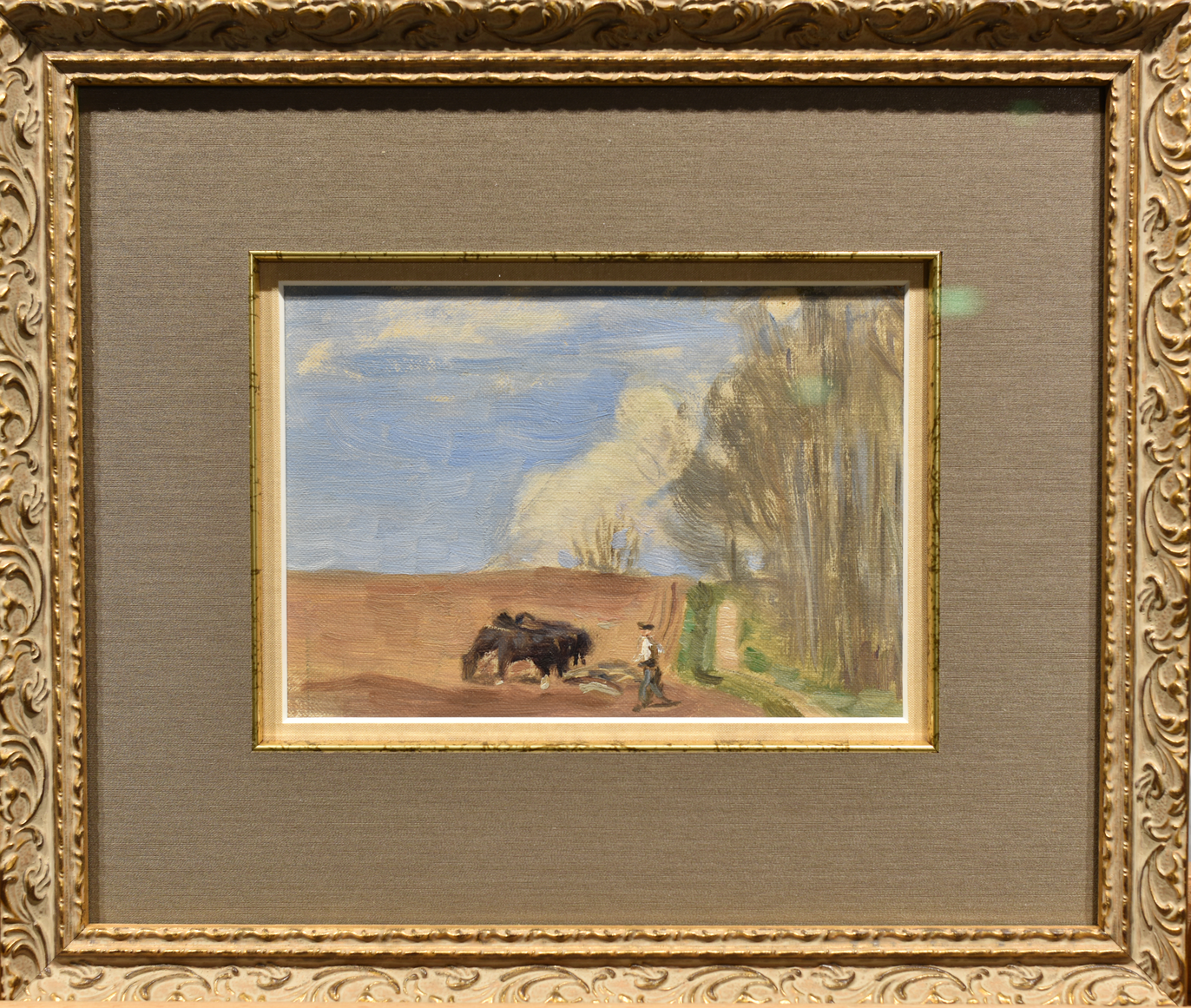
| AUTHOR | Janis Rozentāls |
| PERIOD | 1890's |
| TECHNIQUE | Oil on canvas, cardboard |
| SIZE | 14,5x20,5 cm |
| PRICE | For sale from mid-2025 in The Hague |
Janis Rozentāls
Biography
Latvian painter Janis Rozentāls was born on 18 March 1866 at the Bebri homestead in the Saldus district. Rozentāls came from a modest yet educated and devout family – his father, Miķelis, was a hammersmith, while his mother, Lavīze, worked on a farm. Due to the family’s limited financial conditions, Rozentāls did not complete school and acquired his knowledge through self-education. In his adolescent years, he went to Riga to take up casual work. From 1881 to 1885, Rozentāls was an apprentice to the decorative painters of the Riga Small Guild, obtaining the qualification of journeyman. He later attended the Riga Artisans’ Society School.
At the age of 22, Rozentāls left Riga to study at the Imperial Academy of Arts in Saint Petersburg, where he remained until 1894. He completed his studies with the graduation work “After the Service” (“Leaving the Church”), for which he was awarded a First-Degree Artist qualification – the highest distinction within the Academy’s system at that time. After his studies, Rozentāls undertook travels abroad to Scandinavia and Western Europe. Until 1899, he remained in Saint Petersburg, before later moving to his hometown, Saldus, where he built a studio (now the Janis Rozentāls Saldus Museum of History and Art). In 1901, he moved to Riga, to an apartment at 12–9 Alberta Street, designed for an artist and fitted with a purpose-built studio. The interior of the apartment was arranged according to Rozentāls’ own sketches (now the Janis Rozentāls and Rūdolfs Blaumanis Museum).
In 1903, he married the Finnish singer Elli Forssell (1873–1943). The couple had three children. During the First World War, in 1915, the Rozentāls family moved to Finland. A year later, the artist fell gravely ill with pneumonia and died on 26 December 1916.[1]
Artistic Style
Rozentāls’ work is characterised by diversity, constant creative inquiry, and a richness of sources of inspiration. He left behind an extensive artistic legacy, and his style as a painter may be divided into several creative periods, each defined by a particular tendency of the age or artistic influence.
During his studies, Rozentāls was an active member of the creative association “Rūķis”. Like his like-minded contemporaries, he regarded as one of the guiding principles of his creative work the idea that art should serve spiritual and national values, becoming a symbol of national identity.
The early period of Rozentāls’ work is characterised by realism and the formal principles of academic painting. Over time, these were gradually supplanted by a neo-romantic outlook, whilst Impressionist brushwork and Post-Impressionist colour application became increasingly prominent in his depiction of reality.
A significant influence was also exerted by his study of Japanese art, which fostered the decorative use of colour, stylisation of form, emphasis on the intrinsic value of line, and sinuous rhythms characteristic of Art Nouveau.[2]
Rozentāls’ early sources of inspiration are linked to the work of representatives of the Russian Realist school – Ilya Repin (Ілля Рєпін, 1844–1930) and Vladimir Makovsky (Владимир Маковский, 1846–1920). His view was later significantly broadened by visits to the leading art centres of Western Europe and his acquaintance with the work of such artists as Adolph Menzel (1815–1905), Arnold Böcklin (1827–1901), Jean-François Millet (1814–1875), Franz von Stuck (1863–1928), and Auguste Rodin (1840–1917). The artist was particularly drawn to a subtle, nuanced portrayal of mood, whilst his reflections on the fundamental questions of human existence found expression in symbolic compositions. Rozentāls moved away from broad, literary narrative in his works, favouring laconic expression and attaching ever greater importance to emotional subjectivism.[3]
In terms of subject matter, Rozentāls’ work is dominated by depictions of folk life and everyday scenes. He was one of the first Latvian artists to turn, at the close of the 19th century, to the portrayal of his own people’s life. Rozentāls worked intensively in the landscape genre, painting seasonal motifs and views from his travels in Italy. He was also a sought-after portraitist, immortalising many of his notable contemporaries. The artist was drawn to mythological and symbolic subjects, including motifs of Arcadia and legendary landscapes, which became among the most characteristic of his work. His wife Elli also played a significant role in his creative life, serving as his favourite model. Through his portrayals of her, the artist made a substantial contribution to establishing the mother-and-child motif in Latvian painting.[4]
Rozentāls may be described as a restless seeker of his time. Through his wide-ranging activity, which encompassed painting, graphic art, and applied decorative art, he introduced new principles bound up with the tendencies of the age and the national awakening, thereby becoming, at the turn of the 19th and 20th centuries, one of the founders of professional Latvian art.[5]
Interesting Facts
Rozentāls also wrote and published essays on art. He composed biographical studies of painters of his time – Ādams Alksnis (1864–1897), Vilhelms Purvītis (1872–1942), Rihards Zariņš (1869–1939), and several foreign artists – as well as preparing exhibition reviews and a theoretical essay entitled “Māksla un tehnika” (“Art and Technique”). The promotion of Finnish art also occupied a prominent place in his writings.[6]
In 1910, Rozentāls created the monumental decorative scheme for the facade of the Riga Latvian Society House. To represent the ideals of the first officially recognised Latvian organisational centre, he drew upon the deities of Baltic mythology. The facade decoration became a landmark achievement in Latvian monumental art. Rozentāls chose a novel technical solution suited to the local climate – coloured cement, complemented by a mosaic of gold, silver, metal, and stone – and carried out the technical execution himself.[7]
Rozentāls is the author of several altarpieces held in various churches across Latvia. In Latvian sacred art, he introduced a new understanding of the form and content of the altarpiece in his time. The artist strove for a portrayal of a positive ideal and, in his works, took into account the perception and understanding of the altarpiece’s intended audience – the ordinary person.[8]
The significance and popularity of Rozentāls’ painting are confirmed by figures from his second major solo exhibition, held in Riga at the end of 1913. Over the course of six weeks, the exhibition was visited by 7,242 people, with a record attendance of 951 visitors recorded on its final day. 15 paintings and studies were sold during the exhibition, along with 258 copies of the catalogue.[9]
[1] Pujāte, I. (2025) Janis Rozentāls. Nacionālā Enciklopēdija. Pieejams: https://enciklopedija.lv/skirklis/33967-Janis-Rozent%C4%81ls (vd. 21.11.2025.)
[2] Ibid.
[3] Pujāte, I. Janis Rozentāls. Rīga: Neputns, 2014.–14., 26. lpp.
[4] Ibid. – 32 – 44., 62. lpp.
[5] Ibid. – 6. lpp.
[6] Pujāte, I. (2025) Janis Rozentāls. Nacionālā Enciklopēdija. Pieejams: https://enciklopedija.lv/skirklis/33967-Janis-Rozent%C4%81ls (vd. 21.11.2025.)
[7] Pujāte, I. Janis Rozentāls. Rīga: Neputns, 2014.–98. lpp.
[8] Ibid. – 106. lpp.
[9] Ibid. – 124. lpp.