Biography
Latvian artist Jēkabs Strazdiņš was born on March 13, 1905, in Jaunpiebalga, into the family of a surveyor’s assistant. Already as a child, he learned the rhythm of rural life and showed a talent for drawing and interest in art that were quickly recognized at his local school. In 1924, he enrolled at the Art Academy of Latvia, and in 1926 he joined the “Radigars” art society, but due to a conflict he was expelled and subsequently became a member of the “Green Crow” art association.[1]
In the summer of 1927, Strazdiņš traveled through his native region, creating ethnographic sketches that depicted household items, folk art, buildings, and interiors. In 1933, he went on a study trip to Italy, visiting Venice, Rome, Florence, and the island of Capri. This journey offered him new insights into classical art, and he was particularly impressed by the works of Michelangelo. In the late 1930s, Strazdiņš worked as an art teacher in Rīga and actively wrote articles and art reviews to various periodicals. In the 1940s, he taught the history of Latvian art at both the University of Latvia and the Art Academy of Latvia.
In 1949, Strazdiņš was deported to Siberia. It was only after the fall of Stalin’s regime, in 1954, that he was able to return to his homeland.
The artist died on March 21, 1958, in Rīga.[2]
Artistic style
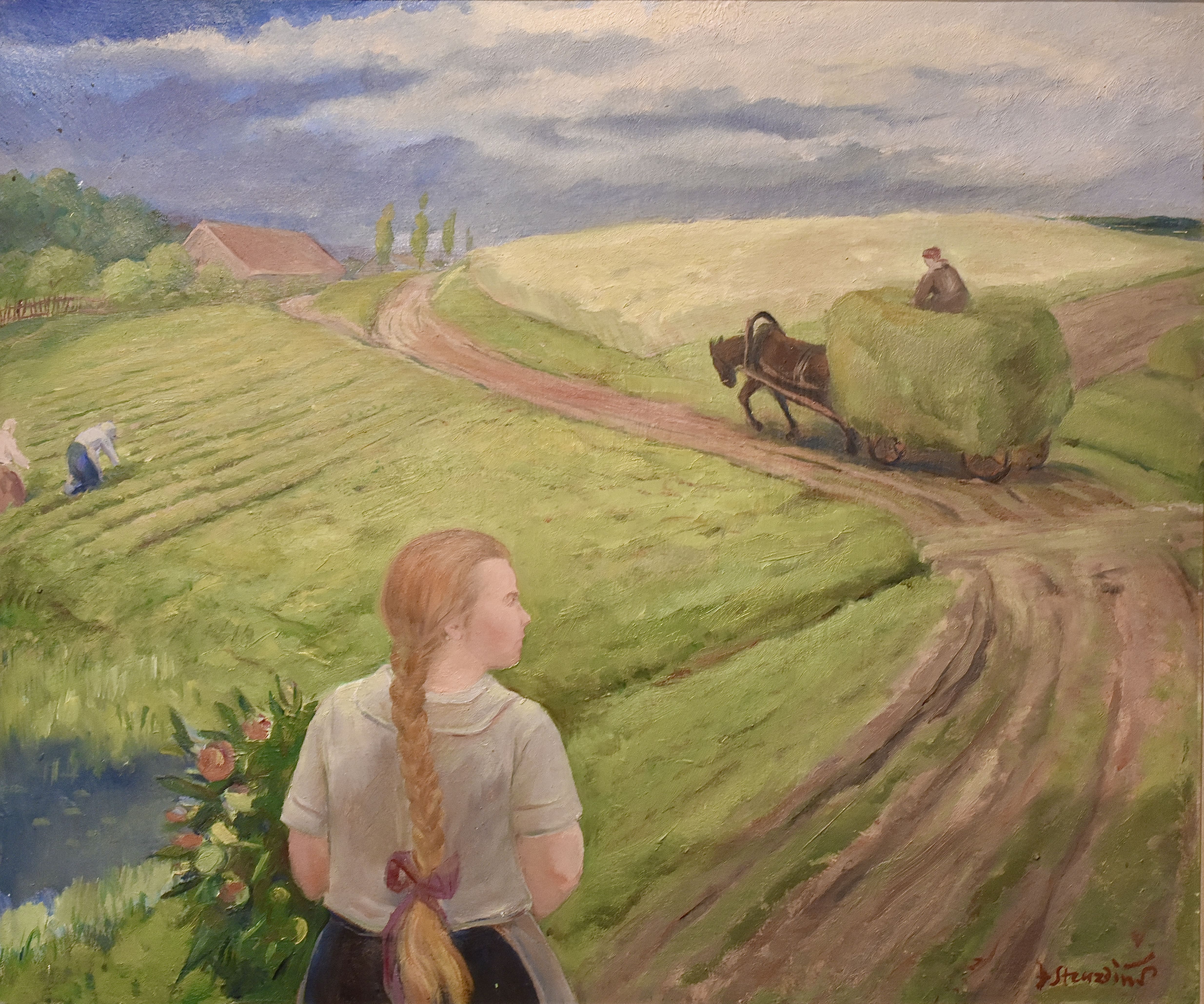
In 1933, Strazdiņš graduated from the Figurative Painting Studio led by Ģederts Eliass (1887–1975) at the Art Academy of Latvia. His artistic style is based on the traditions of the realistic school, and he stands out among his contemporaries as a prominent figurative painter of the interwar period. Rural life was one of the central themes in his artwork. He depicted the hard life of peasants with monumental, dynamic, and powerful imagery – reflecting the 1930s tendency to celebrate rural life as a fundamental spiritual value of the nation. His paintings often portrayed young landowners cultivating their newly acquired land: plowmen, builders, shepherds, hay collectors, and others. Strazdiņš also captured moments of rest for country folk, such as a family dozing or taking a break from work to have a meal. His paintings reveal the influence of the Renaissance and Baroque traditions of the old masters.[3]
Interesting Facts
Alongside his work as a painter and art critic, Strazdiņš collected artworks and founded a museum in his hometown of Jaunpiebalga.
He was actively involved in artistic life, defended the rights of young artists, encouraged them to depict the truth of life, and promoted the idea of “art for everyone, art for the people.”[4]
___________________________