Biography
Latvian artist Alberts Filka was born on August 3, 1891, in Majori, Jūrmala. Inspired by the lives of fishermen, the pine forests, sand dunes, and the sea, he enrolled in the studio of artist Jūlijs Madernieks (1870–1955) in 1909, where he spent three years studying the fundamentals of painting. Among his fellow students were set designer and painter Ludolfs Liberts (1895–1959), Uga Skulme (1895–1963), and Kārlis Miesnieks (1887–1977). Filka continued his art education in Russia, first at the Kazan Art School and later in Saint Petersburg, where he studied at the School of the Imperial Society for the Encouragement of the Arts under the realist Arkady Rylov (1870–1939) and the multifaceted artist Nikolai Rerikh (1874–1947).
In 1915, during World War I, Filka was drafted into military service. After being seriously wounded, he was discharged from service and, in 1917, relocated to the North Caucasus.[1] He returned to Latvia in 1920. Alongside his career as a painter, he also worked as a set designer at the Latvian National Opera and the Latgale Theater and as an art teacher in Rīga as well as in the Latgale cities of Daugavpils and Rēzekne.[2]
The artist died on September 18, 1938.
Artistic style
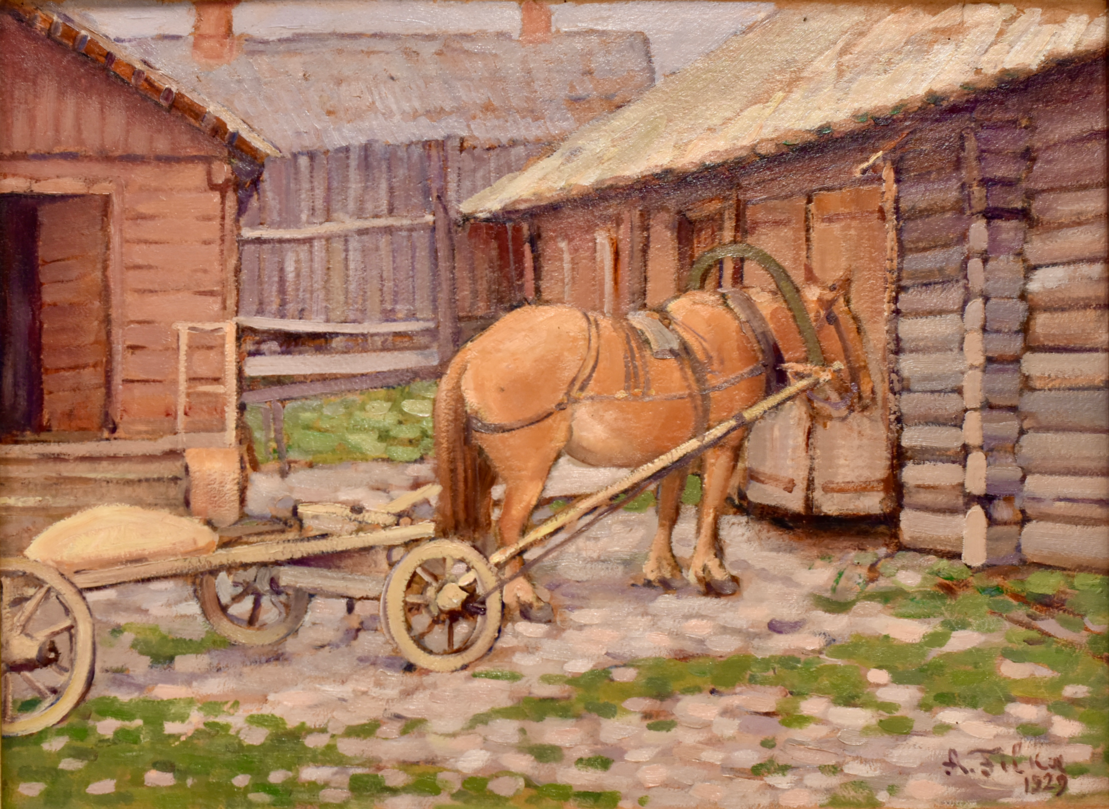
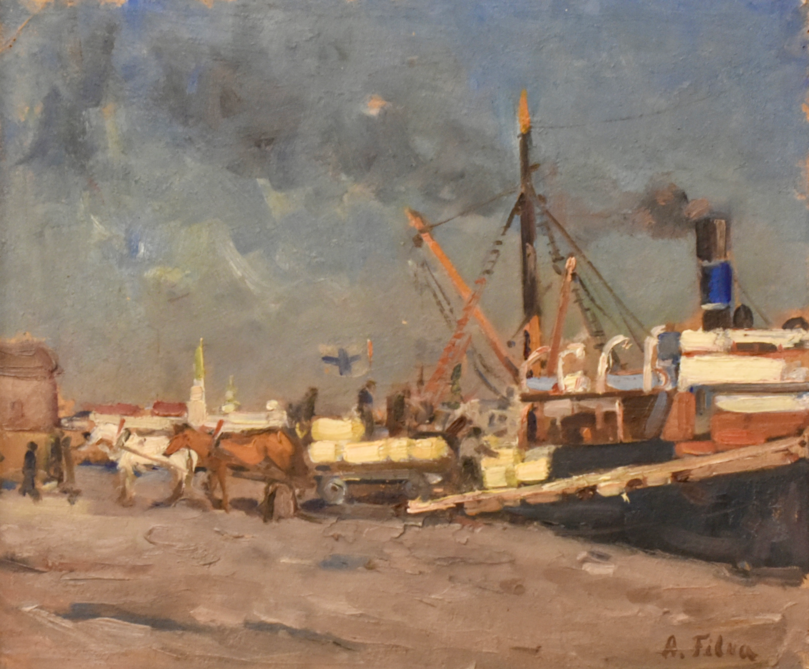
Filka’s artistic style is based on the traditions of realism with elements of impressionism. He mainly painted landscapes of everyday life. In addition to scenes from everyday life, his work also includes landscapes created in the spirit of romantic classicism.[3] Three main themes prevail in the artist’s work: rural life, nature, and horses; the seaside and fishermen; and urban landscapes – streets, markets, and ports. Having grown up in Jurmala, Filka perfectly understood and skillfully depicted the coastline with boats and fishermen by their boats after a catch, as well as seascapes of the surroundings of Roja and Mērsrags, landscapes of Lielupe and Daugava.
Throughout his career, Filka organized numerous exhibitions in Rīga and several cities in Latgale. He also participated in exhibitions held by the Independent Artists’ Association as well as in shows organized by the State Cultural Fund.[4]
Interesting Facts
Between 1917 and 1921, under the influence of Rerikh, elements of fantasy began to appear in Filka’s painting.
Latvian sculptor Gustavs Šķilters (1874–1954) once described the artist by saying, “Filka is not a pioneer, but rather a guardian of reality.” His most vivid and authentic works are those that depict real everyday life and ist moments.
Confronted with the reality of war, Filka turned to military themes in his 1931 works, depicting them in a dark and somber manner.[5]