Biography
Latvian artist Vitālijs Kalvāns was born on September 19, 1909, near Krāslava, in the Latgale region. His father was a mill repair specialist, and the family worked in agriculture. Kalvāns showed an interest in drawing from his school years. He received his basic education at the Ludza Gymnasium, and in 1928, he enrolled at the Art Academy of Latvia.[1]
After graduating from the Academy, Kalvāns returned to Latgale and worked as an art teacher in Rēzekne, Krāslava, and Ludza. For a time, he also served as the head of the Ludza Museum. Kalvāns was one of the initiators behind the establishment of the Rēzekne Art Association and played an active role in the formation of artistic life in Latgale. In 1949, he moved to Rīga, where he worked as an inspector at the Arts Department and taught at the Rīga Secondary School of Applied Arts. From 1950 to 1957, he worked at the “Māksla” factory, then devoted himself entirely to creative work.
The artist died on April 30, 1965.[2]
Artistic style
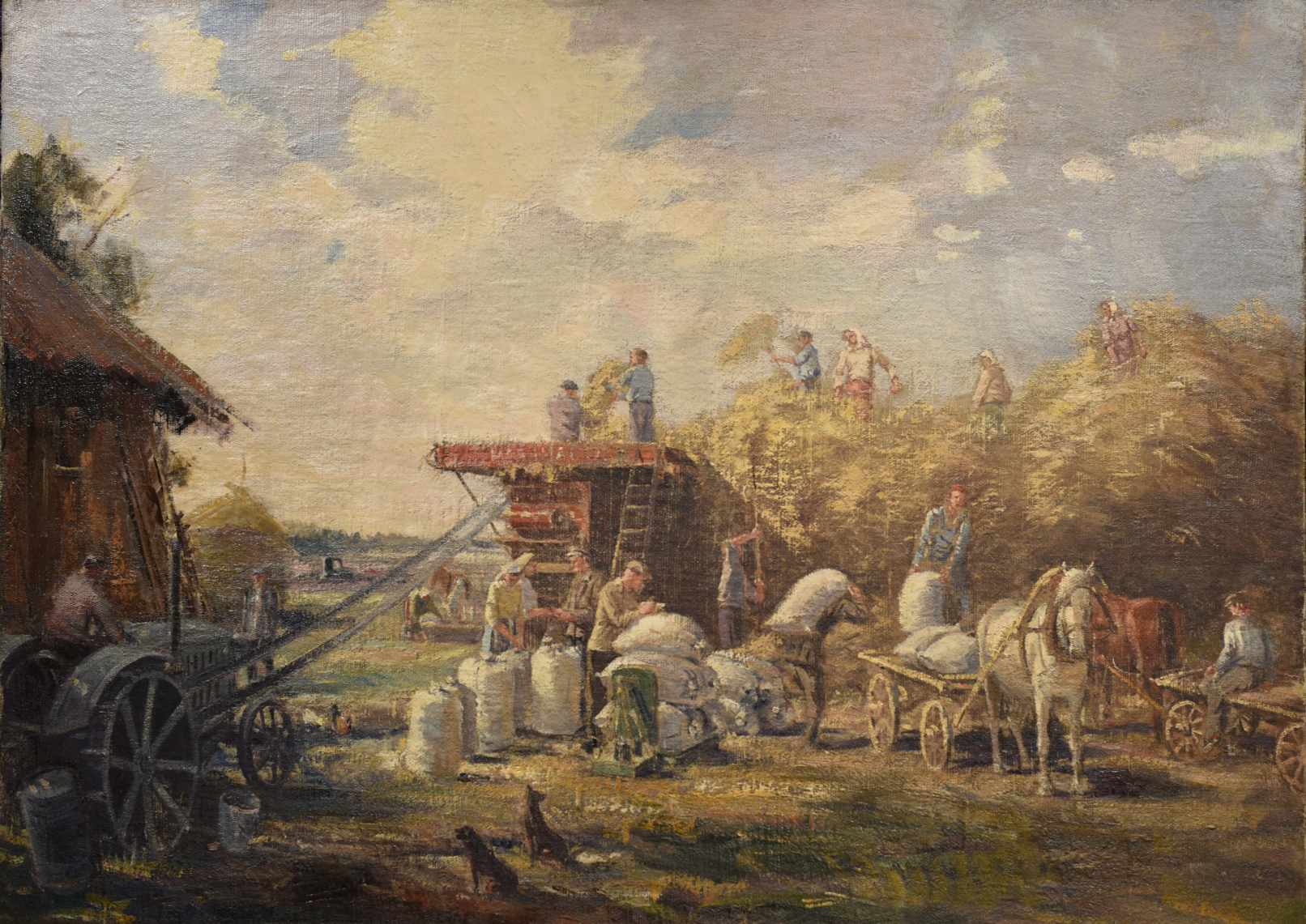
Upon entering the Art Academy of Latvia, Kalvāns chose to specialize in landscape painting and, in 1936, graduated from the studio of Vilhelms Purvītis (1872–1945). The artist was drawn to painting based on the traditions of realism – he mainly painted landscapes, still lifes, and figurative compositions in oil. Kalvāns’ paintings are distinguished by their rich color palette.
Early in his career, his work reflected the influence of Purvītis’s traditions. In the 1940s, the artist temporarily turned to naturalism, which was unusual for him. However, being a talented and emotional artist, Kalvāns soon found his own style in landscape painting. His series of 25 paintings, “In the Places of Rainis’ Life,” received particular recognition.[3]
The main motifs in Kalvāns’ work were the nature of Latgale, everyday scenes, and cityscapes. The precise depiction of details in his works is reminiscent of Dutch and Flemish paintings of everyday scenes from the 17th century.
Kalvāns primarily exhibited his work in Latgale, where he took part in both group and solo exhibitions. He also regularly participated in all exhibitions organized by the Latvian Cultural Fund.[4]
Interesting Facts
In 1949, Kalvāns moved from Latgale to Rīga and settled in the former apartment and studio of the renowned set designer and artist Ludolfs Liberts (1895–1959), where he worked until his death.[5]
_______________________________