Biography
Latvian painter Aleksandrs Štrāls was born on June 12, 1879, in the village of Bebruleja, near Pļaviņas, Latvia.[1] In the mid-1960s, with the construction of the Pļaviņas Hydroelectric Power Plant and the creation of a reservoir, the village of Bebruleja and its cemetery were flooded and are now located approximately 10 meters below the current water level of the Daugava River.[2]
He was born into the family of a raftsman and tanner. His younger brother, Kārlis Štrāls (1880–1970), became a writer. In his youth, the future painter sailed on rafts and worked as a ferryman near Pļaviņas. Around the age of 20, he moved to Rīga, where he spent a few months training at the decorative painting workshops of Kūravs and Pasils.[3] From 1899 to 1902, he studied at the drawing and painting school of painter and educator Venjamins Blūms (1861–1919),
where he quickly demonstrated his skill in composing scenes of everyday life, following the narrative realism tradition of the 19th century. In 1902, Štrāls went to St. Petersburg and enrolled in the school of the Imperial Society for the Encouragement of the Arts, but due to financial difficulties, he was forced to abandon his studies.[4]
Returning to Rīga, he worked as a scenographer at the Rīga Russian Theatre, the Apollo Theatre, and the New Rīga Theatre. During World War I, he worked in a field hospital. From 1918 to 1920, he worked as a drawing teacher in the Kuban region, Russia. In early 1921, he returned to Latvia and settled in his native town of Pļaviņas, where he taught drawing at the Pļaviņas Gymnasium until 1929.
The artist died on October 7, 1947, in Pļaviņas.[5]
Artistic style
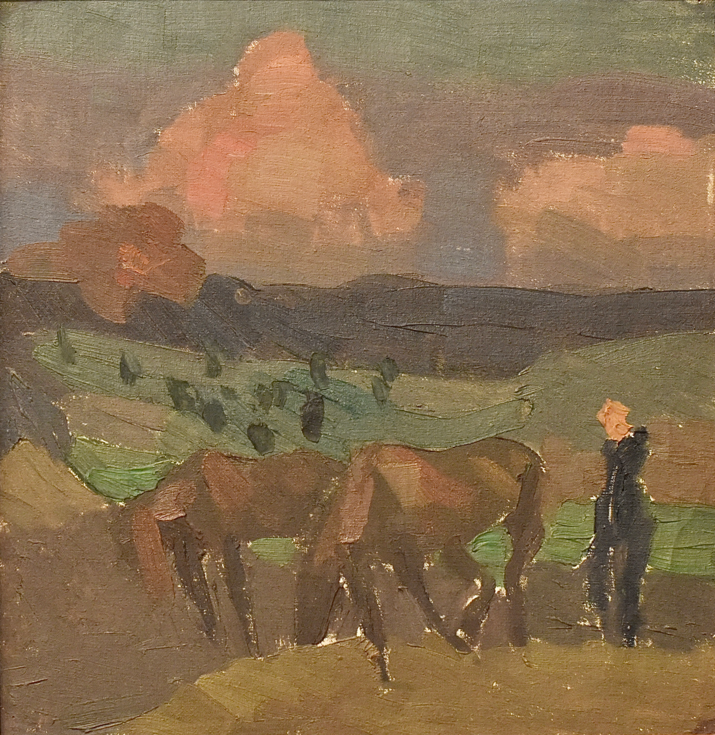
Štrāls’s painting is rooted in the tradition of realism, although the artist himself sought to distance himself from academic conventions. His distancing from the style he had acquired in the studio of Blūms was largely influenced by the relatively free and expressive works of painters Vilhelms Purvītis and Janis Rozentāls, which he saw at local art exhibitions, as well as by the creative impulses of his friends. Štrāls was not especially interested in academic education, as he believed that the works of art academy students were too uninspiring and that academic routine stifled genuine talent.
Štrāls primarily worked in the genres of landscape, genre scenes, and portraiture. His artistic style is characterised by realism, enriched by the modern impressionistic approach of his time – visible in his use of color and broad, softly blended brushstrokes that unified form. Latvian nature and the lives of local people served as the central themes in his art.[6]
During his artistic career, he illustrated the publications of his like-minded friends and colleagues, – the so-called “Decadents” – including “Dzelme” and “Stari”. He was a member of the Independent Artists’ Association and, in 1904, took part in the Baltic Art Exhibition in Koknese, Latvia. He also organized several exhibitions in private venues in Rīga.[7]
Interesting Facts
Štrāls was part of the bohemian group of creative figures of his time. Among his closest friends were writers Jānis Akuraters (1876–1937), Jānis Jaunsudrabiņš (1877–1962), and painter Voldemārs Zeltiņš (1879–1909). Writer Kārlis Štrāls described it in his memoirs as follows: “The bohemian life of writers and artists at that time was empty to the point of starvation but insanely ideal in the very whirlwind.”
According to the recollections of Jānis Akuraters, the bohemian lifestyle, “in the truest sense of the word,” began in 1904 – initially during the Baltic Art Exhibition that summer in Koknese, and later in poet Kārlis Jēkabsons’ (1879–1946) small house in Riga, located in the Grīziņkalns district at 7 Rūjienas Street. That autumn, “in two rooms lived what felt like an entire colony of poets and painters,” while many others gathered there “for literary and artistic debates.” Later, the bohemian group relocated to the rented apartment of Jānis Jaunsudrabiņš’s family at 5 Cēsu Street, and in 1906, they moved again – this time to Avotu Street, where the Štrāls brothers “rented a large and bright room in the home of a kind carpenter.”[8]
[1] https://www.literatura.lv/personas/aleksandrs-strals (v. 10.05.2025).
[2] https://visitaizkraukle.lv/pieminas_vietas_skulpturas_pieminekli/bebrulejas-pieminas-akmens (v. 10.05.2025).
[3] Ibid.
[4] Latvijas mākslas vēsture. – 4. sēj.: Neoromantiskā modernisma periods: 1890–1915 / Sast. E. Kļaviņš, aut. E. Kļaviņš, K. Ābele, S. Grosa, V. Villerušs. – Rīga: LMA Mākslas vēstures institūts; Mākslas vēstures pētījumu atbalsta fonds, 2014.–308. lpp.
[5] https://www.literatura.lv/personas/aleksandrs-strals (v. 10.05.2025).
[6] Latvijas mākslas vēsture. – 4. sēj.: Neoromantiskā modernisma periods: 1890–1915 / Sast. E. Kļaviņš, aut. E. Kļaviņš, K. Ābele, S. Grosa, V. Villerušs. – Rīga: LMA Mākslas vēstures institūts; Mākslas vēstures pētījumu atbalsta fonds, 2014.– 308.–309. lpp.
[7] Ibid.–140.–141. lpp.
[8] Ibid.–140. lpp