Biography
Latvian artist and art critic Oļģerts Saldavs was born on July 29, 1907, in Smolensk, Russia, where his father had been administratively exiled for three years due to his involvement in the 1905 Revolution. After returning to Latvia, his father took up farming on the family estate near Koknese. A talented draftsman himself, he encouraged his son to pursue art as well.
After the destruction left by World War I, young Saldavs actively helped with farm work, learning about the land and agriculture. He completed secondary school in Rīga, where he developed an interest in art and initially attended the art studio of Uga Skulme (1895–1963). He later studied in the studios of Ludolfs Liberts (1895–1959) and Kārlis Miesnieks (1887–1977). In 1927, he enrolled at the Art Academy of Latvia and, in 1935, graduated from the landscape painting workshop led by Vilhelms Purvītis (1872–1945).[1]
Alongside his career as an artist, Saldavs was actively involved in literary activities. Until 1948, he worked at the newspaper “Rīts”as an art critic, writing exhibition reviews, catalogue texts, and publishing monographs on artists.
During World War II, the artist spent some time living in Germany but returned to Latvia in 1945. After his return, he worked for several years as a teacher at the Janis Rozentāls Art School and the Rīga Secondary School of Applied Arts.
From 1951 to 1958, Saldavs was a graphic designer at the “Māksla” art factory and worked for two years at the editorial office of the magazine of the same name.
The artist died in Rīga on April 1, 1960.[2]
Artistic style
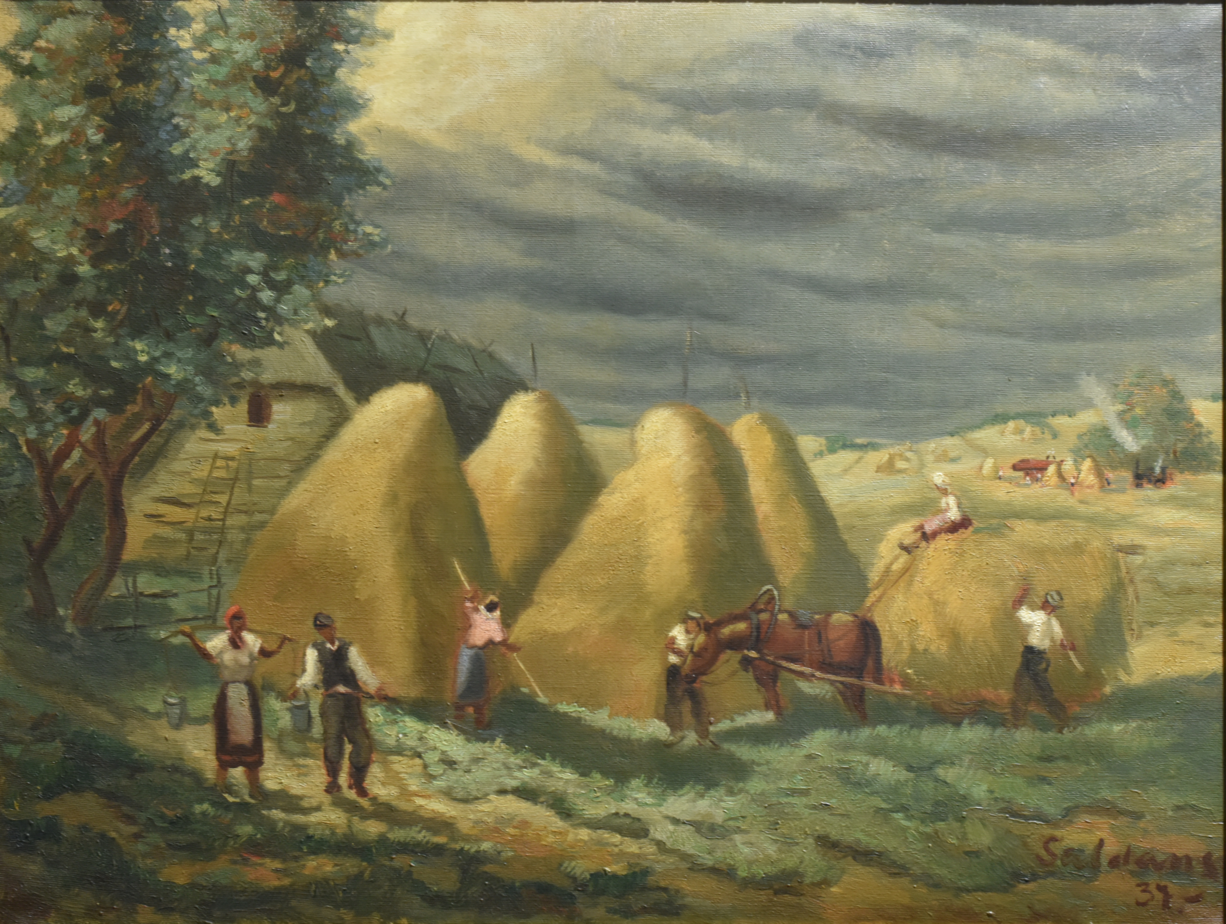
Saldavs’ artistic style is based on the traditions of realism. He often went on summer plein air painting trips to Koknese together with Konrāds Ubāns (1893–1981). His works are characterized by a greenish-gray and brownish-yellow color palette. Saldavs succeeded in capturing the calm atmosphere of Koknese and the central Vidzeme region across different seasons, often incorporating human figures into his compositions. Depicting rural work or skaters on a winter pond, he emphasizes genre components, evoking associations with 19th-century Dutch painting, where nature is depicted panoramically but at the same time with fine details.[3]
Interesting Facts
As a writer and art historian, Saldavs published several works, including a collection of poems entitled “Dzejas” in 1929 under the pseudonym O. Saldaus, as well as several monographs on artists: in 1943, “Eduards Kalniņš: Biography and 58 Reproductions of Paintings”; in 1957, a biographical essay on artist Jānis Kalmīte; and in 1958, a monograph on Vilhelms Purvītis.[4]
_____________________________
[1] Siliņš J. Latvijas māksla 1915–1940 II – Stokholma: Daugava, 1990.–111.–112. lpp.
[2]
https://www.literatura.lv/personas/olgerts-saldavs (vd.18.07.2025)
[3] Siliņš J. Latvijas māksla 1915–1940 II – Stokholma: Daugava, 1990.–112. lpp.
[4]
https://www.literatura.lv/personas/olgerts-saldavs (vd. 18.07.2025)